
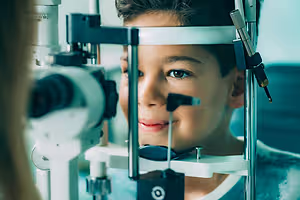
Myopia Management for Children in Livingston, Warren & East Brunswick, New Jersey
We offer myopia management options, including MiSight® 1-day contact lenses and orthokeratology (ortho-k), to help families address progressing nearsightedness.
No locations match that search.
Seesaw Vision Center
Seesaw Vision Center-Warren
Seesaw Vision Center-East Brunswick

Please take a moment to let others know about your experience visiting our practice.
We really appreciate the feedback!

Childhood Nearsightedness Can Progress as the Eyes Grow
Myopia, or nearsightedness, often develops when the eye grows too long, making distant objects look blurry.
As children grow, their nearsightedness may increase, leading to stronger glasses prescriptions. An increasing prescription can be a sign that myopia is progressing.
Monitoring these changes helps determine when myopia management may be appropriate.
Slowing Myopia Progression May Help Reduce Future Eye Health Risks
Higher levels of myopia are associated with an increased lifetime risk of certain eye conditions, including retinal detachment, glaucoma, and myopic macular degeneration.
Myopia management aims to slow the progression of nearsightedness during childhood. Reducing progression may help lower some of the risks associated with developing higher myopia.
Treatment does not guarantee that nearsightedness will stop progressing or prevent future eye disease.
MiSight® & Ortho-K Offer Different Approaches to Myopia Management
Standard prescription glasses correct blurry distance vision but do not necessarily slow myopia progression.
Myopia management uses specially designed treatment approaches that aim to reduce how quickly nearsightedness increases.
MiSight® 1 day lenses are daily disposable soft contact lenses designed to correct nearsightedness and slow its progression in eligible children.
The lenses are worn during the day and discarded after use. Suitability depends on your child's prescription, eye health, age, and ability to wear contact lenses safely.
Orthokeratology, or ortho-k, uses specially designed rigid contact lenses worn overnight to temporarily reshape the cornea.
This can provide clearer vision during the day without glasses or contact lenses. Ortho-K may also help slow myopia progression in appropriately selected children.
Because the lenses are worn overnight, proper cleaning, handling, and regular monitoring are important.
A Myopia Assessment Helps Determine Which Treatment Suits Your Child
Your child's age, prescription, eye health, and previous prescription changes all influence which myopia management options may be appropriate.
An assessment helps establish how their nearsightedness has progressed and whether MiSight® or ortho-k should be considered.
Treatment selection also involves practical factors, including your child's daily routine and ability to follow lens care instructions.
Regular Follow-Up Visits Help Track Myopia Progression
Myopia management involves ongoing monitoring rather than a single appointment.
Follow-up examinations help assess prescription changes, eye health, and how your child is responding to treatment.
The recommended schedule depends on the treatment selected and your child's individual needs.
Outdoor Time May Help Reduce the Risk of Developing Nearsightedness
Research suggests that spending more time outdoors during childhood may reduce the likelihood of developing myopia.
Outdoor activities can support healthy daily habits, but they do not replace prescribed myopia management for children whose nearsightedness is already progressing.
The evidence for slowing existing myopia through additional outdoor time is less certain.
Practical Considerations Before Starting Myopia Management
Treatment Eligibility Depends on Your Child's Prescription & Eye Health
MiSight® and ortho-k have different suitability requirements. Your child's age, prescription, eye health, and ability to manage contact lenses can influence which option may be appropriate.
Contact Lens Hygiene Is Important for Safe Treatment
Both treatments require appropriate lens handling. Discard MiSight® lenses after daily use, while ortho-k lenses require cleaning and storage.
Overnight contact lens wear increases infection risk, so careful hygiene and professional monitoring are especially important.
Myopia Management Requires an Ongoing Commitment
Treatment generally involves continued lens use and follow-up visits. The duration and monitoring schedule depend on your child's age, treatment, and response.
Treatment Costs Depend on the Option Selected
MiSight® and ortho-k have different lens, fitting, and follow-up requirements.
Contact your preferred office—Seesaw Vision Center, Seesaw Vision Center-Warren, or Seesaw Vision Center-East Brunswick—to ask about current treatment fees, insurance information, and appointment arrangements.
Take the Next Step When Your Child's Nearsightedness Is Progressing
An increasing prescription is a reason to discuss myopia management with an eye doctor.
Contact Seesaw Vision Center, Seesaw Vision Center-Warren, or Seesaw Vision Center-East Brunswick to arrange an assessment and learn which treatment options may be appropriate for your child.
Glasses may remain part of your child's vision correction, depending on the treatment selected. Your eye doctor can explain when glasses may still be needed.
Eligibility depends on the treatment, your child's age, prescription, eye health, and ability to follow lens care instructions. MiSight® and Ortho-K have different suitability considerations.
Many children can continue participating in sports. The appropriate vision correction and protective eyewear depend on the activity and treatment selected.
Yes. Myopia management aims to slow progression, not necessarily stop it completely. Individual treatment responses vary.
The appropriate next step depends on the treatment. Follow the prescribed wearing schedule and contact your eye doctor for guidance if treatment is interrupted.
Treatment duration depends on age, prescription changes, and the chosen approach. Your eye doctor can recommend when treatment should continue, change, or stop.